Why elite European academies fail to produce elite centre-forwards
400,000-700,000 years ago. Olorgesaille, Kenya. The homoerectus species, our direct ancestors, were out hunting.
All they possessed were stones, sticks, spears, each other and an insatiable need to survive.
The ‘prey’ they were after weren’t no hares or fat cows you could easily put down without struggling. They hunted goliaths. Woolly mammoths, rhinoceroses, bears, reindeer and wild horses were all potential meals. On paper, these prehistoric humans should’ve never been able to takedown such animals. They were less than half the size and weight, didn’t have access to serrated teeth and claws or protective fur. But they made their ordinary figure and lackluster physical abilities work and they made them work well. Otherwise I wouldn’t be here typing this thing now.
What made the homoerectus believe they could hunt and kill these animals 3x the size of them? And what made them so successful in doing so?
Well what other choice did they have? If they didn’t kill these animals, they’d die through starvation. It’s as simple as that. They adapted, using an array of tactics and teamwork to reach their objectives.
It’s common knowledge that wars are catalysts for great technological developments and inventions. WWI saw the birth of radio communication, WWII gave us radar and early computers and the Cold War presented to us the earliest iterations of the internet. Wars accelerate development because countries need to serve their militaries’ needs. They will stop at nothing to ensure they’re put in the best place to win the war.
What spurs this ambition? It’s obvious, because if they don’t - the ramifications will be disastrous and lives will be lost. They had to force the needle. Had to innovate.
In the legendary Big L’s (slightly controversial) posthumous album: ‘Harlem’s Finest: Return of Of The King’ lies a song, the 17th track - labelled ‘How Will I make It (I Won’t)’. One of the better songs on the project, it’s Big L at his lyrical peak but the message he’s conveying in the track is different. Instead of discussing all the nefarious things he likes to get up to on the day-to-day, he takes a moment to tell us how hopeless and miserable his upbringing was.
It gives you time to sit back and feel empathetic towards a musician who never relayed weakness on his songs. But without Big L’s tough circumstances growing up, we most likely would never get Big L. Because it’s that hunger same he experienced from being just a child that you can still hear laced in every track he lays down. It's that drive and cantankerous attitude that made him so admirable but was derived from a life of struggle.
But the same reason why Big L was able to come from a life of nothing to become one of the most revered MC’s to ever touch the mic is same reason why the homoerectus were able to successfully hunt the beasts that roamed the earth half a million years ago and the same reason why without all the death and destruction of war, we wouldn’t be anywhere near as technologically advanced as we are now.
Because in the pitfalls of struggle, when your back is against the wall and the odds are against you, only one thing will keep you going. The hunger and determination to make it out.
And to make it out, you harness everything in your environment to aid you in the process. You think creatively, you adapt to your surroundings and you take risks.
But what happens when you’ve never had to struggle? What happens when the environment designed to develop you removes hardship altogether?
The best football academies in Europe remove scarcity and delay players’ exposure to the men’s game. And for strikers, the most instinctive position in football - it’s becoming a real problem.

Image via barcauniversal.com
The CIES Football Observatory and International Football Academy release an annual list of the best academies in world football featuring the familiar names of Benfica, Barcelona, Chelsea, Ajax, PSG and so on.
These academies have been synonymous with the production of world-class talents for years and years. And there’ll be no slowing down in that regard. But, a recent article by The Athletic made me notice something.
Hardly any of the European academies are producing world-class strikers.
All can call upon a hoard of world-class wingers, midfielders and defenders who climbed through the ranks to become elite professional football players. Centre-forwards? It’s a different story
The specific Athletic article is titled ‘Why doesn’t La Masia produce strikers for Barcelona?’ but you can extend that out to the whole continent. For the last 10-15 years, the biggest clubs in Europe with best academies around have struggled to produce high-class centre-forwards who have gone on to reach the highest level.
Let’s take the big 6 English teams. Each of them have academy graduates currently operating in the first team and most have numerous. However, there’s no strikers and there haven't been any for 90% of the time.
Eddie Nketiah had spells when he was heavily involved in first team football at Arsenal. Tammy Abraham had an impressive season and a half with Chelsea where he looked to potentially be their striker for the next 10 years. But after that where are we? Liverpool, Man City, Man United - there’s almost nothing to go off.

Charlie Mcneill (22) was an extremely highly rated striker back in his youth days. He went viral on social media for scoring over 500 goals in the academy. Image via manutd.com
Harry Kane is the only centre-forward who’s been able to make the jump and become a regular fixture for his boyhood club, and that makes him an anomaly. And if you dig deeper into the career paths of England’s most prolific strikers of the last decade, you begin to notice a running theme.
Ollie Watkins, Ivan Toney, Jamie Vardy and Harry Kane. All have hit more or less 20 Premier League goals in a season (Watkins’ highest is 19). But what’s interesting is they all spent a lot of time playing in the lower tiers of English football.
Watkins spent 4 years in League 2 at Exeter City and one in the National North & South at Weston Super Mare before joining Brentford. Toney was a fixture of League One football with Barnsley, Shrewsbury, Scunthorpe, Wigan and Peterborough and spent 2 seasons in League 2 at the hands of Northampton. Vardy dovetailed in the National League and National North and South for two seasons before joining Leicester in the Championship and Kane was out on loan at Leyton Orient in League 1 at the age of 17 followed by spells at Millwall, Norwich and Leicester City before Tim Sherwood gave him a chance.
Can this be coincidence?
In an interview with Onefootball, Harry Kane spoke about the taking the jump from academy football to the men’s game: “The guys are big, strong, fast. They’re smart. They block you off, they grab hold of you when you get too tight. And you have to learn how to deal with it.”

Harry Kane at Leyton Orient. Image via Thetimes.com
“And you have to learn how to deal with it.” You have to learn how to go from being the best player on the pitch, faster and stronger than everyone, playing on pristine pitches - to being just an ordinary player. You can go score hundreds of goals in the academy because you’re physically stronger than the teenagers and young adults you’re coming up against, but the men’s game isn’t the same.
At the highest level academies (such as the CIES top 30), you’re playing with 10 other players who will likely be individually better than the other 11 they’re up against. You don’t need to worry about missing one big chance because your teammates will carve out another opportunity for you. You don’t know what it means to be truly hungry because you’re always being fed. And unless you’re playing the other top academies, you’ll more often than not always be able to get the best out of the centre-back you’re up against.
The jump from under 21’s football to men’s is huge, it doesn’t matter if you’re going from Chelsea to Burton, you’ll undoubtedly have a much harder time battling with the hard-headed veterans that will kick you, stamp on you and make your life hell for 90 minutes. But that’s how you find the small details, the little tricks and tools to add to your arsenal that will make you better goalscorers.
That’s why South American academies produce world-class strikers at a much higher rate than top European institutions. They chuck them in at the deep end of men’s football at young ages and tell them to go out and swim. Julian Alvarez wasn’t wasting away in the reserves at eighteen - he was already playing a handful of games for River Plate. At the same age, Joao Pedro had scored 10 goals for Fluminese’s first team and both are now some of the best strikers in the world.

Joao Pedro at Fluminense as a schoolboy. Image via ge.globo.com
When observing Transfermarkt’s list of the top 14 most valuable strikers in the world, all had already racked up a decent amount of minutes at senior level at 17-18. Not a single one was biding their time in the academy of an elite European team (To put that in perspective, there were 7 midfielders and 9 defenders who were). In France, it’s not the PSG striker who was smashing in goals at youth level who’s placed in that top 14, it’s Hugo Ekitike and Marcus Thuram who were getting senior minutes at Reims B and Sochaux B respectively in the fourth tier of French football.
When young strikers are playing against fully grown men at such young ages, they’re completely out of their comfort zone. The ball isn’t on the floor as much as they’re used to, they can’t stiff-arm their opponent to shield the ball as easily and all of a sudden everyone is faster and stronger than them. It’s then, and only then, they begin to seek out new ways to gain an advantage. Whether it’s through clever movement, unorthodox finishing methods (the trademark Ekitike toe-poke) or through sheer and relentless hard-work and harassment (Jamie Vardy).
All strikers want to do it to score goals. How many times do you hear ‘there’s no better feeling than scoring a goal’ come from their mouth? It’s all they’ve known. But when their comfort blanket gets ripped away from them and it is no longer easy to do the only thing they’ve been so good at doing, it creates a hunger and desire to find different ways to soothe their starvation. It sparks creativity. When their team doesn’t create many chances, they have to make sure that when one does come their way, they’re in the right place to put it away. Because in men’s football, unless you’re playing for a very few number of teams, you aren’t going to have multiple chances put on a plate for you. In men’s football you have to be able to sniff the opportunity.
In top academies, the trend we see now is to keep around the academy strikers scoring countless goals until they’re 19/20 and have nothing but some inconsistent minutes off the bench or starts in meaningless cup ties to write home about. By the time they get their first real taste of consistent senior level football, the expectations to hit the ground running are huge. Whilst the reality is often there will most likely be a struggle to adapt. And there’s nothing wrong with that because they aren’t bad players, they’re just unexposed. Dominic Solanke is one of the most potent academy strikers to come out of the UK in the last 10 years and it took him 4 seasons of senior football to reach double figures for goals. It’s a process.

Dominic Solanke netted 12 goals in 9 games in the UEFA Youth League in 2014/15
But there are also other reasons why centre-forwards at home to Europe’s elite aren’t finding fortune in the men’s game.
The clubs they are at are rich. Strikers in the top academies will never be given much chance for their boyhood club straight off the bat because their position is too important. Teams only play with one of them and they’re competing with multiple multi-million pound players for minutes. It’s the same reason why young academy keepers struggle to see any real first-team minutes unless they go on loan. Big clubs would refuse to take such a gamble in the areas of the pitch where the margins are so fine. If you do get the chance to play some first-team minutes and you aren’t scoring right away, there’s your chance gone - just like that.
There’s also the fact that top academies are now advocating for a style of football which diminishes the goalscoring ability of number 9s, making it harder to adapt to senior football where the physical side of the game matters so much.
In a recent YouTube video, Chelsea legend John Terry spoke about the quality of modern day strikers:
“In the academy at Chelsea we have number 9s that have drifted away into, I call it the Thierry [Henry] role… because they want the ball at their feet. They want to kind of face the defender.
I don’t see too many players other than Haaland in today’s football that get on the shoulder of a centre-half and want to stretch and make those runs in behind as well.”
Since Pep took over English football, it seems the majority of coaches have been trying their best to emulate his playing style in one way or another and it’s trickled down to academy football. They want the ball kept on the floor and strikers are demanded to drop deep and aid with build up instead of focusing on getting in the positions to score goals.
Harking back to The Athletic article previously mentioned, a quote that stuck out was Jordi Roura, former La Masia director on the discourse on certain young strikers in and around the Barcelona youth ranks, saying he was told “he’s a good player, but he only scores goals”. As if that’s meant to be a problem.
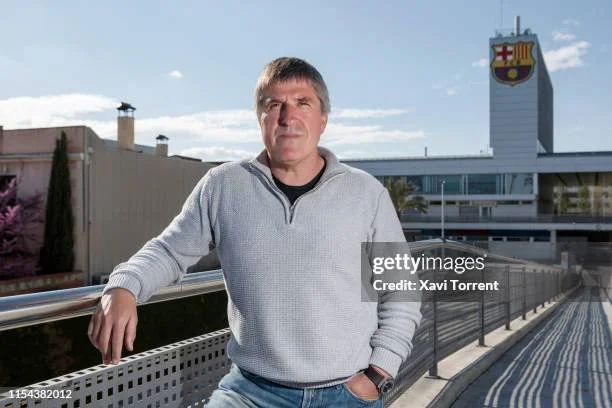
Jordi Roura was La Masia director from 2014-2021
Phillip Lahm explained the current issue in top academy coaching as he passionately conferred about the lack of specialists in German football. In a recent Athletic article he wrote: “The old craft is missing in attack, running to the near post, working against robust defences and repeating the same movements until they become second nature.” Because every high level striker will tell you these are the things which separate them from everyone else. And it’s not just in Germany, across Europe these basic instincts aren’t being instilled into young centre-forwards anymore.
For whatever reason, top academies have stopped sending out their most prized youngsters on loan at younger ages, instead preferring to reward them with a few appearances on the bench. Perhaps clubs lower down in the English pyramid are reluctant to take gambles on unproven players at the senior level, but I doubt that to be the case because many clubs would surely relish the chance to build strong links with a Premier League team, such as what Chelsea and Swansea used to have or what Watford and Man City are building now.
Strikers, more than most other positions, need to experience men’s football as soon as possible. They need to know what it feels like to really be hungry for goals and feel their way through the intensity of the men’s game. You can have the best facilities, tactics and coaches around, no academy football will match the ferocity of the men’s game.
If a striker finds scoring goals in academy football easy, he shouldn’t still be scoring goals in academy football.
